What charging connector does my SURRON have?
LP20 3-pin, 4-pin or the new 6-pin: how to tell which one your bike has, what every pin does, and why the newer ones refuse to charge until the charger says hello over CAN bus.
By Kevin Graehl, Electric Moto Garage · San Francisco · Updated November 2026
TL;DR
- Look at the charge port on the top left of the battery and count the pins. 3 pins = original Light Bee or Light Bee X. 4 pins = 2023 to early 2026 Ultra Bee. 6 pins (two big, four small) = mid-2026 Ultra Bee or the 2026 Light Bee 2.
- The 3-pin Light Bee port is dumb: two wires, no handshake. Any charger with the right voltage works.
- The 4-pin and 6-pin ports are smart: two thick wires carry the charge current and two thin wires carry CAN bus, so the charger has to talk to the battery before it will charge.
- The 6-pin adds a "presence" pin so the battery knows a plug is in even before anyone talks.
- Same 6-pin plug does not mean same charger. The mid-2026 Ultra Bee is 20 series and the Light Bee 2 is 22 series. Order by bike, then by plug.
- Need to switch? Our plug adapter goes 4-pin to 6-pin or back, and we make a 6-pin connector you can actually buy.
On this page:
- Which connector do I have?
- Photos and pins
- Light Bee: the 3-pin era
- Ultra Bee: the 4-pin flip
- 2026: the 6-pin connector
- Light Bee 2
- Three battery "languages"
- Other charge plugs
- What is CAN bus?
- The SURRON bus, drawn out
- How we decode it
- Fun CAN facts
- What's next
- FAQ
Why the model year does not help (yes, it is confusing)
Honestly, this part is confusing and annoying, and it is not your fault. Here is what we know about SURRON Ultra Bee batteries:
- 2023, 2024 and 2025 Ultra Bee batteries all talk to the charger the same way (the same battery CAN protocol). The 2026 battery talks a different way.
- Many retailers sold 2024 bikes as “2025” and 2025 bikes as “2026”, so the year on your receipt or paperwork is often wrong.
- A mid-2026 version of the Ultra Bee has a 6-pin charge port. Every other Ultra Bee uses the 4-pin port.
So go by your battery, not the paperwork. What matters is the plug and what the battery itself reports to the charger, not the year you were sold. The charge port is on the top left of the battery on the Ultra Bee, Light Bee X and Light Bee 2, right where you can see it. Count the pins and pick the charger with that plug. Still not sure? Text a photo of your charge port to 415.341.2281 and we will tell you which one you have.
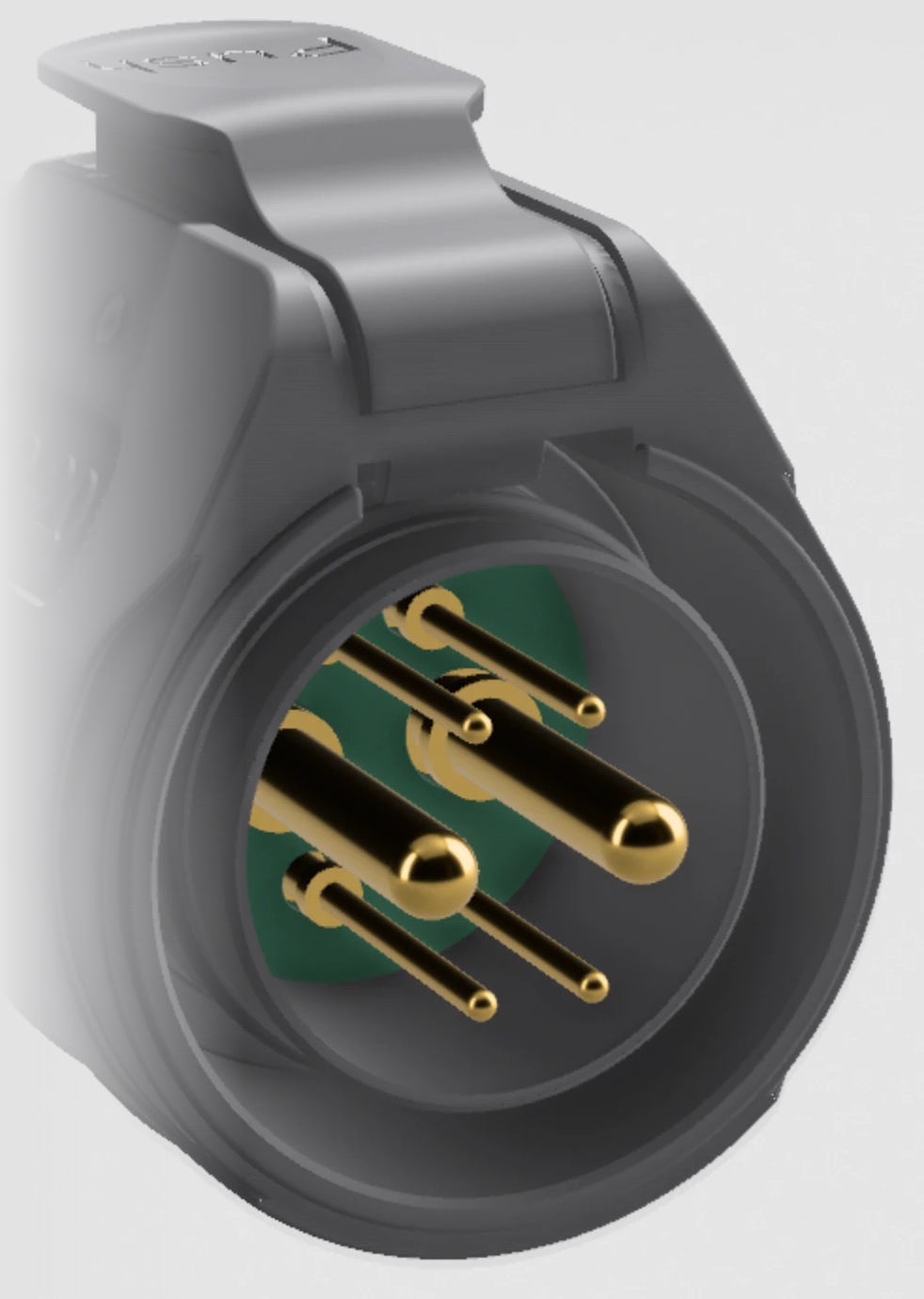
Why did SURRON change the plug? Our honest take: the 6-pin port is SURRON’s way of telling aftermarket companies to kick rocks. No worries. I designed my own 6-pin plug in CAD, “opened a mold” in China (that is how they say it there; here we call it injection molding) and had 500 sets made. See the EMG 6-pin connector →
Which charging connector does my SURRON have?
The fastest way to know is to look. Find the charge port on the top left of the battery and count the pins. Then use this table.
| Connector | Bikes | Years | Pins used | Talks to the battery? |
|---|---|---|---|---|
| LP20 3-pin | Original Light Bee, Light Bee X | From the first Light Bee | 2 of 3 (positive, negative) | No handshake |
| LP20 4-pin | Ultra Bee | 2023 to early 2026 (most Ultra Bees) | 4 of 4 (positive, negative, CAN-H, CAN-L) | Yes, CAN bus |
| 6-pin (two large, four small) | Ultra Bee, Light Bee 2 | Mid-2026 Ultra Bee; Light Bee 2 | 5 of 6 (positive, negative, presence, CAN-H, CAN-L) | Yes, CAN bus + presence |
Model years overlap, and many bikes were sold as the next year (why). Always count the pins on your own bike before you buy a charger or a cable.
Photos and pins
Each connector has two halves: the battery side (the port on the bike) and the charger side (the plug on the cable). Below is what each pin does. Tap a labeled photo to open it full size.
LP20 3-pin (Light Bee, Light Bee X)
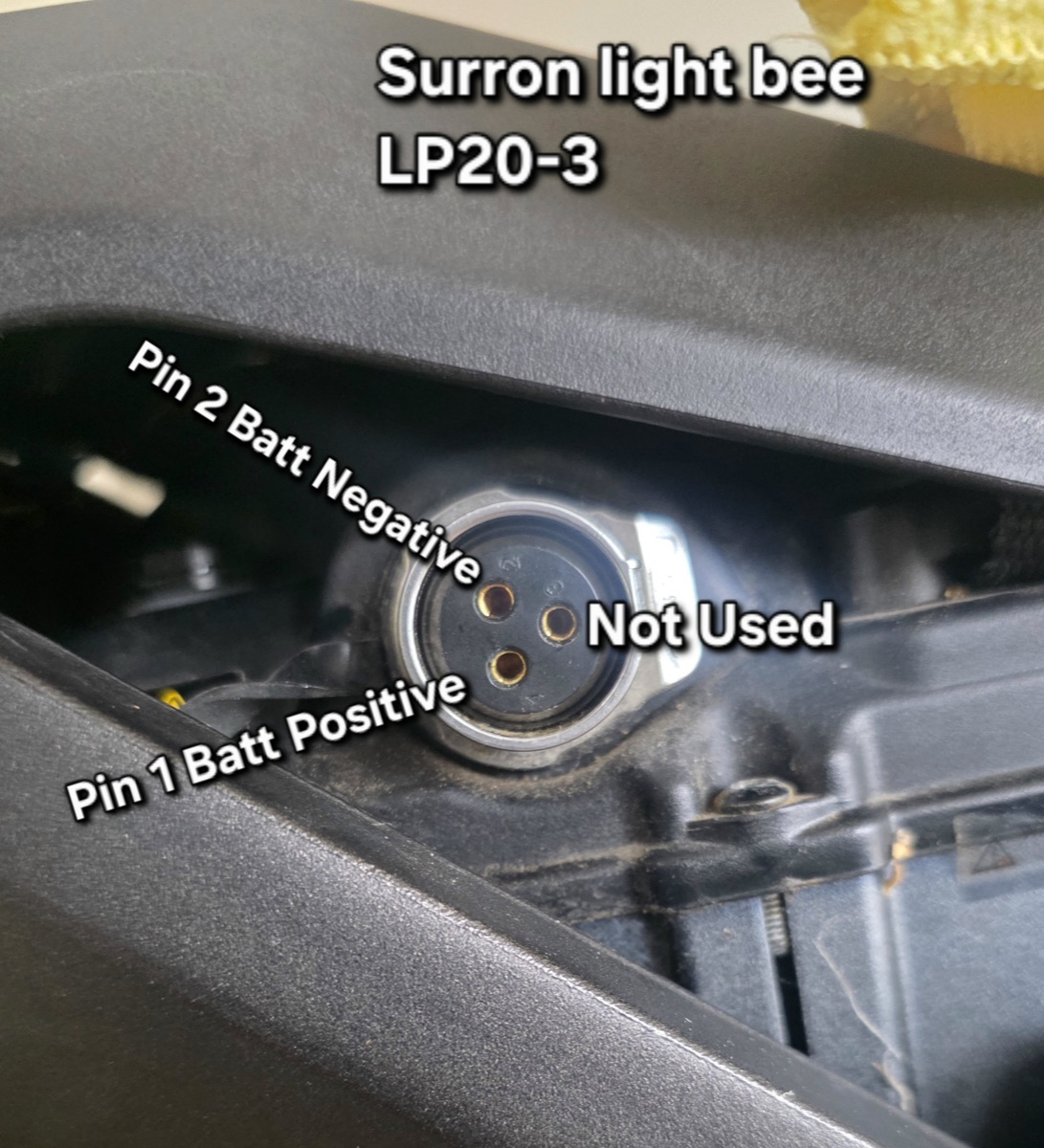
- Pin 1: battery positive
- Pin 2: battery negative
- Pin 3: not used
LP20 4-pin (2023 to early 2026 Ultra Bee)
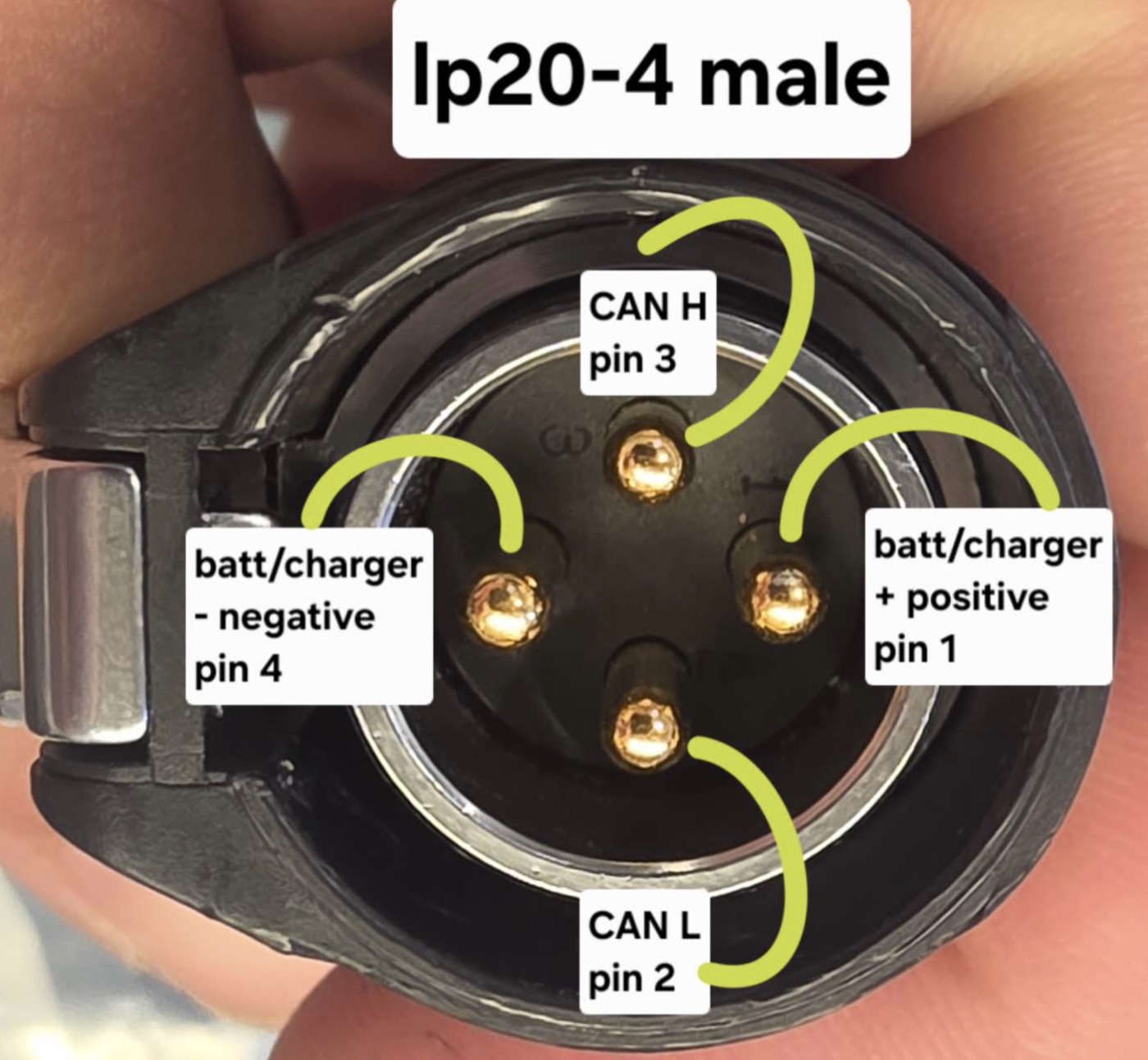
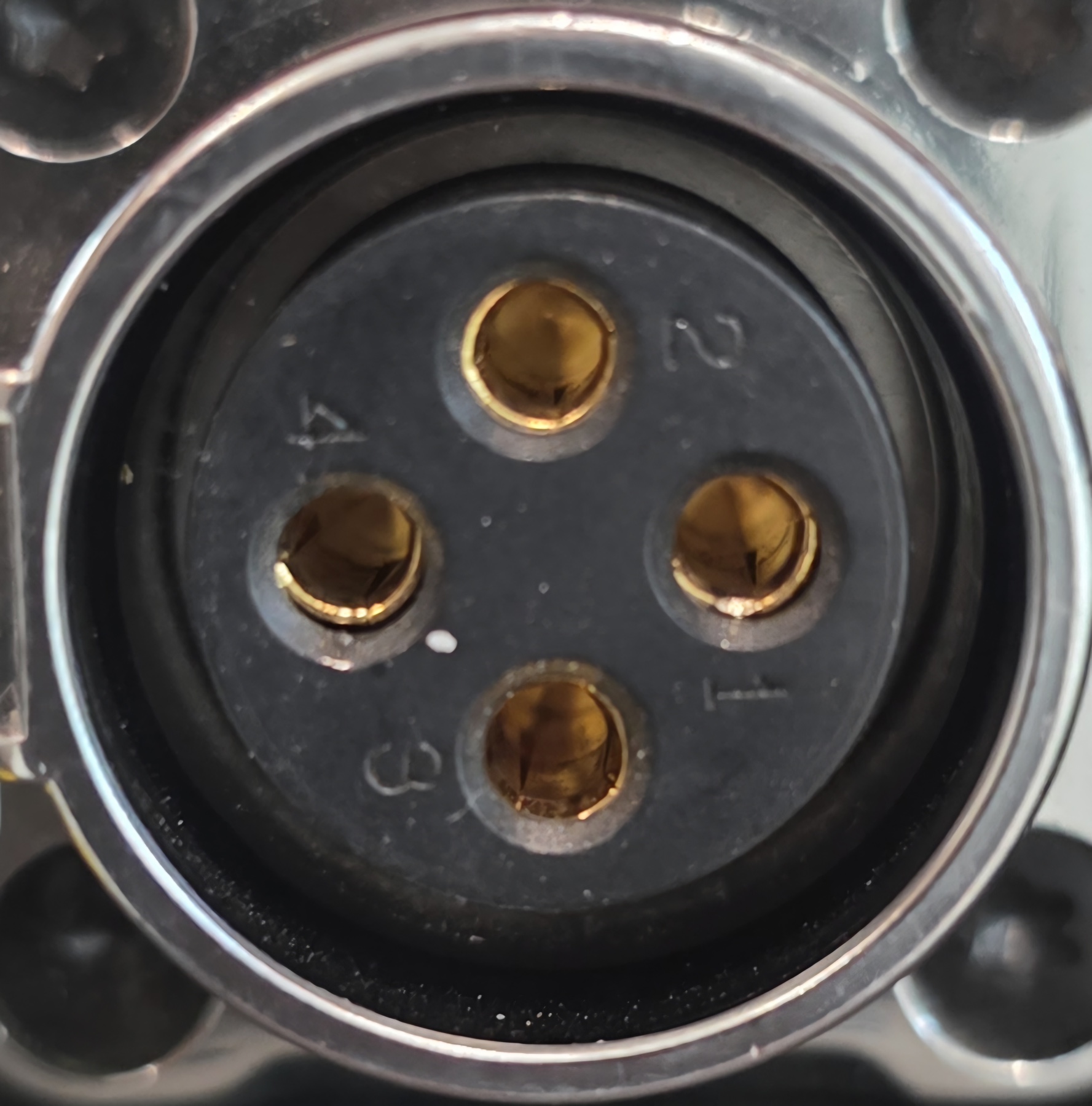
- Pin 1: battery positive (thick)
- Pin 2: CAN-L (thin)
- Pin 3: CAN-H (thin)
- Pin 4: battery negative (thick)
6-pin (mid-2026 Ultra Bee, Light Bee 2)
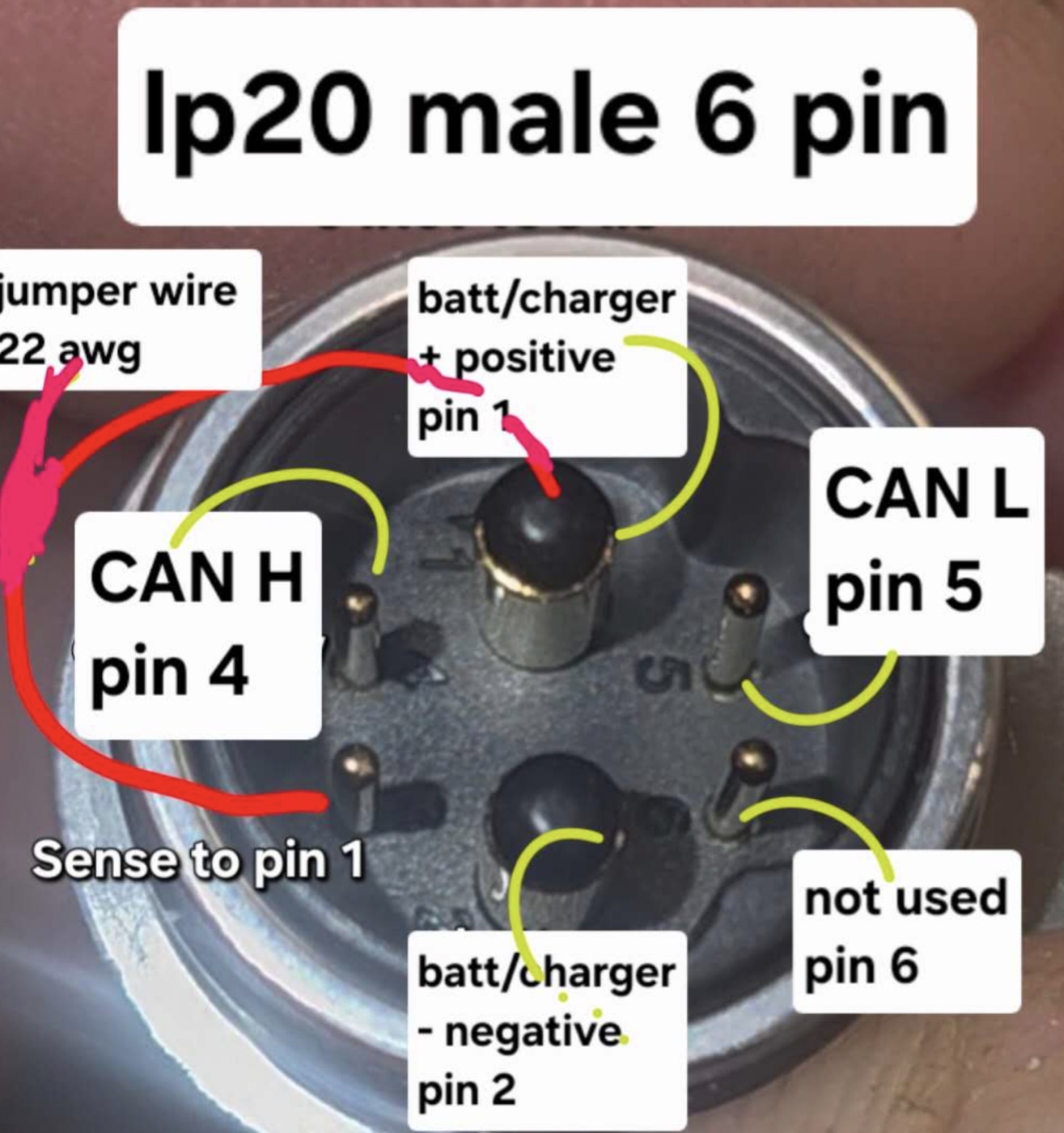
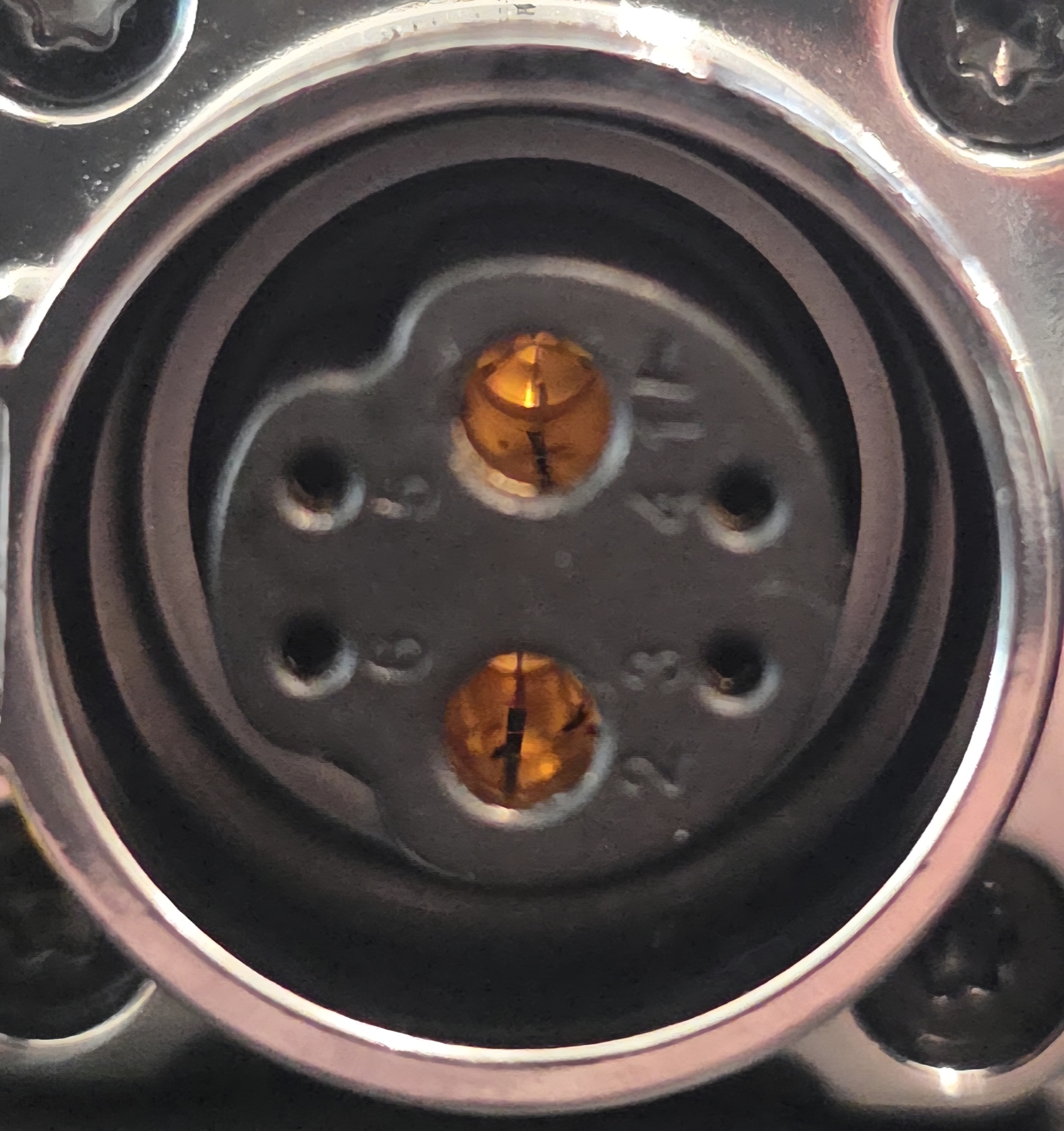
- Pin 1: battery positive (large)
- Pin 2: battery negative (large)
- Pin 3: presence (wake). The charger plug ties it to positive, so it sits at full pack voltage
- Pin 4: CAN-H
- Pin 5: CAN-L
- Pin 6: not used
Pin numbers are as molded on the connector insert. Check the numbers printed on your own part before wiring anything.
Light Bee: the 3-pin era
The original SURRON Light Bee and the Light Bee X used a round LP20 3-pin connector. LP20 is a family of waterproof circular connectors made by CNLINKO. Only two of the three pins were used: positive and negative. That's it.
No data wires meant no handshake. The battery took whatever voltage you gave it, so almost anything with the right voltage could charge it: a bench power supply, a standard 16-series (60 V nominal) e-scooter charger fitted with an LP20 3-pin plug and even a long string of AA cells wired in series. Simple, cheap and easy to fix. Also easy to get wrong, because nothing on the bike checks that the charger is the right one.
Ultra Bee (2023): the 4-pin flip
The Ultra Bee flipped everything. It moved to a 4-pin connector from the same LP20 family, and four is the minimum you need to carry both DC power and CAN bus.
Inside an Ultra Bee charge cable there are two kinds of wire:
- Two thick wires (about 14 AWG) carry the charge current, in the range of 10 to 15 amps.
- Two thin wires are CAN bus: CAN-H and CAN-L. It is the same idea as the OBD2 diagnostic port under a car's dashboard.
Those two thin wires change the whole relationship. The Ultra Bee battery does not just accept voltage. Its battery management system (BMS) waits for a charger that talks to it, checks what the charger says, and only then lets charge current in. A plain power supply, however good, gets nothing. That is why so many owners find that a "universal" charger shows 0.00 amps on an Ultra Bee.
Mid-2026: the 6-pin connector
On the mid-2026 Ultra Bee and the Light Bee 2, the charge port changed again, to a 6-pin connector with two large pins and four small ones. Five of the six pins are used.
The new trick is a presence pin. Inside the charger plug, positive is jumped across to one extra pin. The moment the plug goes in, the battery sees voltage on that pin and knows a charge tip is connected, even before any CAN message is sent. It is a physical "someone's here" signal on top of the conversation.
The connector comes from the same maker as the 4-pin, but SURRON had a custom tip made for both the battery side and the charger side. You can't buy it off the shelf.
We made our own 6-pin connector
We'll be straightforward: SURRON has not made this easy for anyone outside SURRON. The 6-pin tip isn't sold on its own and there is no public drawing, which leaves independent battery builders, charger makers and riders with a melted plug stuck.
So Kevin designed a one-to-one copy in CAD, sourced custom pins, and paid a connector company for the injection mold. It is built to match the original where it matters:
- Current rating on the two large pins.
- Press fit, so it seats in the original port the way the factory plug does.
- Latch body, so it clicks and stays put.
- Dielectric properties: very high insulation resistance, so nothing leaks through the plastic between pins.
It is for sale to riders as the 6-pin charger connector. Third-party battery and charger makers: we sell it to you at a little over cost, because more good chargers on the market is good for every rider. Text 415.341.2281 for bulk orders.
Light Bee 2 (LB2, 2026)
The Light Bee 2 looks like the replacement for the Light Bee X. It uses the identical 6-pin connector and nearly the same CAN framing as the 2026 Ultra Bee, with some nuances. The big difference is voltage: the LB2 battery is 22 series (it charges to 94.16 V), while the Ultra Bee is 20 series. Same plug, different battery. Never charge a Light Bee 2 with an Ultra Bee charger, or the reverse.
Three battery "languages" (so far)
Right now there are three different ways a SURRON battery expects a charger to talk:
- 2023, 2024 and 2025 Ultra Bee. All three years speak the same language.
- mid-2026 Ultra Bee. Same idea, but the negotiation is different. A charger that speaks only the older language will not charge it.
- Light Bee 2 (6-pin). Close to the 2026 Ultra Bee, with its own differences and a higher voltage.
Our chargers are built per bike for exactly this reason. See all Bee Chargers, or use the 4-pin ↔ 6-pin plug adapter to fit an older or newer bike.
Other charge plugs
Not every battery uses a SURRON-style port. Aftermarket packs, scooters and other e-motos use barrel plugs, XLR, Anderson and more. Our Charge Tips guide covers plug sizes and which charger tip fits what.
What is CAN bus?
CAN stands for Controller Area Network. Bosch developed it in the 1980s so that the growing pile of electronics in a car could share one network instead of running a separate wire for every signal. It went into production cars in the early 1990s and today is in nearly every car, truck and electric vehicle.
Before CAN, devices usually talked over point-to-point serial links, and later over RS-485. Those work, but a serial link usually connects just two devices, and an RS-485 network needs one device in charge deciding who may speak. CAN is more robust:
- Two wires, many devices. Every device (a "node") connects to the same two wires, CAN-H and CAN-L. Everyone hears every message.
- No boss needed. Any node can start talking. If two start at once, the more important message "raises its hand" and wins, and the other simply waits and tries again a moment later. Nothing is lost. Engineers call this arbitration.
- Noise-proof. The two wires carry opposite signals and are twisted together, so electrical noise from a motor hits both equally and cancels out. That matters a lot on an electric motorcycle.
- Self-checking. Every message carries a checksum. If any node sees a bad message, it flags it and the sender repeats it. A node that keeps causing errors takes itself off the bus so it can't jam everyone else.
How many devices can share one bus? In practice the limit is set by the electronics, and common CAN transceivers are rated for around 100 or more nodes on a single bus. Real vehicles usually split into several buses well before that. A SURRON uses just a few.
How fast is SURRON's CAN bus?
SURRON's battery and bike bus runs at 500 kbit/s. That is the same speed most cars use on their OBD2 diagnostic port (the ISO 15765-4 standard). It is not J1939, the heavy-truck standard, which usually runs at 250 kbit/s and uses its own message rules. SURRON uses the common speed but its own private messages, so a car OBD2 scanner won't understand it.
The SURRON bus, drawn out
On a SURRON, only three devices live on CAN: the OEM display, the motor controller (a main node) and the battery. A smart charger joins the same conversation through the charge port while it is plugged in.
Swipe sideways to see the whole diagram.
Notice what is not on the bus. The high/low beam indicator, hazards and turn signals are plain LEDs powered straight from the handlebar push-button switches. They never send a CAN message, so no CAN reader, including our BeeLatch, can see them. If a product claims to read your turn signals off SURRON's CAN bus, ask how.
How we decode it (and why this page has no codes)
SURRON does not publish its CAN protocol. Everything we know comes from long listening: hours of captures on real bikes, batteries and chargers, matched up against what the bike was doing at that moment. Slowly, the numbers start to mean something.
We may publish our decode once it is mature. But we are careful about it, and so this page deliberately contains no message IDs, frames or byte layouts. Listening is harmless. Sending is not. A wrong message sent onto the bus can confuse the controller or the battery, damage them, or bypass the safety checks that keep a 20-series lithium pack from overheating. Done wrong, that is a fire risk, not just a warranty problem.
Fun CAN facts
What's next
- More bikes. On the original Light Bee family (including the Light Bee X), the battery, controller and display talk over RS-485 instead of CAN (see our Light Bee RS485 write-up). We are decoding it now, and we believe the Hyper Bee uses RS-485 too. We have both in the shop.
- Screens for other bikes. The BeeDash HUD works with Fardriver and VESC controllers today, and on the Light Bee X (text first). For the Hyper Bee, the BeeDash HUD Wide is taking $1 holds. The 4.3″ hardware has Bluetooth, RS-232, RS-485 and CAN.
- TORP controllers. Not started. They probably talk CAN to the OEM battery. We don't know yet whether their display link is standard CAN or something proprietary.
- Two speeds in one charger. Inside our Bee Charger Touch 17A, the charger's own electronics talk CAN at 250 kbit/s while the bike's battery talks at 500 kbit/s. Two buses can't share wires at different speeds, so the charger uses two CAN transceivers, one per bus, and brings both sets of data onto one screen. It works, it just takes more development time.
Questions
What charging connector does my SURRON have?
Count the pins in the charge port. Three pins is the original Light Bee or Light Bee X (LP20 3-pin). Four pins is a 2023 to early 2026 Ultra Bee. Six pins, two large and four small, is a mid-2026 Ultra Bee or the 2026 Light Bee 2.
Why won't a regular charger or power supply charge my Ultra Bee?
The Ultra Bee battery waits for the charger to talk to it over CAN bus before it lets charge current in. A plain charger or power supply never says anything, so the battery stays closed and the charger shows about 0 amps. The 3-pin Light Bee has no handshake, which is why almost any charger with the right voltage worked on it.
Can I use a Light Bee 2 charger on a mid-2026 Ultra Bee?
No. They share the same 6-pin plug, but the Light Bee 2 battery is 22 series and charges to 94.16 V, while the Ultra Bee is 20 series. Order a charger by bike first, then by plug.
Can I charge a 6-pin bike with a 4-pin charger?
With the right adapter and a charger that speaks the newer battery's language, yes. Our 4-pin to 6-pin plug adapter goes either way and works with every Bee Charger.
What is the presence pin on the 6-pin connector?
Inside the charger plug, positive is jumped to one extra pin. When the plug goes in, the battery sees voltage on that pin and knows a charger is connected, even before any CAN message. It sits at full pack voltage, so never bridge it by hand.
What is CAN bus?
A two-wire network that lets many devices share the same wires. Everyone hears every message, and if two talk at once the more important message wins and the other waits. Cars, trucks and SURRON's Ultra Bee and Light Bee 2 all use it.
What speed is SURRON's CAN bus?
500 kbit/s, the same speed most cars use on their OBD2 port (ISO 15765-4). It is not J1939, the truck standard. SURRON's messages are private, so a car OBD2 scanner won't understand them.
Can BeeLatch read my turn signals or high beam?
No. On a SURRON the turn signals, hazards and high/low beam indicator are plain LEDs powered by the handlebar switches. They are not on CAN bus, so no CAN reader can see them.
Do you publish the SURRON CAN protocol?
Not now. SURRON publishes nothing, and our decode comes from long listening and captures. Sending the wrong message can damage a controller or battery or bypass safety checks, so we only share it when it is mature and safe to do so.
Related.
Bee Chargers
Chargers that talk to the battery. Built per bike: 4-pin, 6-pin, Light Bee 2.
Plug adapters
4-pin to 6-pin, 6-pin to 4-pin, and J1772.
6-pin charger connector
Our 1:1 copy of the mid-2026 tip. Build or repair a cable.
BeeLatch
Listens to your bike’s CAN bus and shows it on your phone.
Battery Reviver
Reads every cell over CAN when the charger won’t start.
Dead battery guide
Why parked packs die and how a safe recovery works.