See which exact factory part numbers appear across Sur-Ron models. Light Bee 2 is highlighted, and every shared part explains which other model catalog it came from.
NEW CATALOGLight Bee 2 cross-reference
Parts marked “also used on” were found under the identical factory part number in another model catalog.
Technical library · kept on this site
Manuals you can actually search.
Service procedures, owner's manuals, installation guides, diagnostics, diagrams, and model changes—organized by bike instead of buried in PDF downloads.
Hyper Bee evolution · 2025 to 2026
The second year brought a real voltage, power and control-system upgrade.
The names can be confusing: sellers commonly describe the packs by cell count and rounded nominal voltage, while Sur-Ron's own tables use 48 V for 2025 and 58.08 V for 2026.
2025 · V1
14S / “52 V” generation
Factory battery listing
48 V · 25 Ah
Common pack description
14S · about 51.8 V nominal
Maximum power
5 kW
Factory top speed
55 km/h · 34 mph
Depending on setup, rider and conditions, this version is often discussed as a roughly 35–37 mph bike. That is real-world shorthand, not the printed factory rating.
2026 · MY26
16S / “60 V” generation
Factory battery listing
58.08 V · 22 Ah
Common pack description
16S · about 59.2 V nominal
Maximum power
8 kW
Factory top speed
65 km/h · 40 mph
The 2026 bike is often described as a roughly 40–45 mph machine. The factory manual specifies 65 km/h; tire size, state of charge, rider weight and speedometer variation affect observed speed.
REMOTE INTERCOM + LISTEN-BACK
Talk to the rider—and hear the child answer.
Hold the remote's MIC button to send your voice through the bike speaker. Triple-press MIC to turn on the bike/dashboard microphone and transmit audio back to the remote in real time. The bike microphone defaults off each time the motorcycle powers on.
IMPORTANT LEVEL 1 LIMITATION
Softer power is not a true under-10-mph governor.
Level 1 reduces power delivery and acceleration, but it does not provide a parent-selectable hard speed ceiling below 10 mph. A child can still build speed with enough distance. Treat Level 1 as a gentler throttle/power mode—not a walking-speed lockout.
NEW FOR 2026
SAWC anti-wheelie assistance.
The 2026 manual adds Sur-Ron Anti-Wheelie Control with four settings: W0 off plus W1, W2 and W3 intervention levels. It uses posture sensing to reduce unintended wheelies, but Sur-Ron explicitly says it is assistance—not an accident-prevention guarantee.
Factory references: 2025/V1 manual pages 16 and 51; MY26 manual pages 17–18 and 55; Hyper Bee Remote guide pages 9–10. The sub-10-mph limitation is EMR operating guidance, not a quoted factory claim.
Start with the symptom. Prove the cause before buying a part.
This is a first-pass field guide, not a substitute for the factory service procedure. Record the exact behavior, dashboard message, recent work, crash history, battery state, and conditions when the fault appeared.
Stop and inspect before ridingDo not test-ride a bike with weak or missing brakes, a sticking throttle, damaged high-voltage wiring, a loose battery, smoke, heat, arcing, fluid leakage, or obvious crash damage.
WON'T DRIVE
Dash is on, but the motor will not respond
Check for an active brake cutoff, deployed side stand, abnormal throttle input, ride-mode state, and a displayed fault code. Cycle power only after the controls return normally.
NO POWER
No dash or lighting after key-on
Confirm battery state of charge and seating, key position, main connector engagement, fuse condition, and visible harness damage. Do not repeatedly reconnect a hot or melted terminal.
BRAKES
Noise, weak braking, or an inconsistent lever
Inspect pad and rotor wear, contamination, caliper alignment, lever damage, fluid leakage, and hydraulic pressure. A lever that reaches the bar or loses pressure means the bike stays parked.
DRIVETRAIN
Vibration, chain noise, or motor spins without drive
Look for dry or tight chain links, damaged guards, loose axle hardware, spoke problems, bearing play, sprocket damage, and primary-drive failure. Find the source before applying more throttle.
SUSPENSION
Harsh travel, scraping, leakage, or poor tracking
Check fork alignment, preload and damping settings, linkage freedom, contamination, and seal condition. A light film and an active leak are different—drips or rapid oil accumulation need service.
CONTROLS / ELECTRICAL
Sticky throttle, loose battery, or intermittent operation
Verify throttle clearance and return, battery latch preload, rubber supports, connector condition, and harness routing. Intermittent power under bumps often points to a mechanical connection problem first.
After a tip-over or crash
Do a stationary inspection before restoring power.
Key off and stabilize the bike.
Check fork and handlebar alignment.
Inspect both brake controls, rotors, calipers, footpegs, wheels, sprockets, and exposed wiring.
Make sure the throttle turns freely and snaps closed.
Power up only after the bike passes the mechanical check; do not ride if steering, brakes, or high-voltage parts are questionable.
For an accurate parts inquiry, include the model year, fault code, clear photos of the installed part and connector faces, and the factory part number when visible. Similar-looking components are not proof of fitment.
Ultra Bee power guide
The battery—not just the controller—sets the limit.
A controller can request more current than the original pack can deliver comfortably. Battery current, phase current, peak duration, temperature, state of charge, and model year all matter.
Practical stock-pack ceiling230 A
Treat 230 battery amps as a conservative short-duration ceiling discussed by Torp users—not a continuous factory rating. At nominal pack voltage that is roughly 17 kW before voltage sag.
Do not confuse theseBattery A ≠ Phase A
Battery amps are drawn from the pack. Phase amps circulate between the controller and motor and can be much higher. An “800 phase amp” tune does not mean the battery is supplying 800 A.
Heat and time decidePeak is not continuous
A brief pull that works once may still overheat cells, busbars, connectors, the fuse, or BMS when repeated. Cold battery, low charge, and sustained climbing reduce the available margin.
ADVANCED / EXPERIMENTAL
What a BMS shunt modification actually does
Some advanced builders add resistance in parallel with the BMS current-measurement shunt. That makes the BMS report less current than the battery is truly delivering, which can delay its overcurrent cutoff. The linked community example reported the BMS seeing about 230 A while calculated actual current was roughly 373 A.
This does not increase the cells’ safe current capability. It intentionally makes current measurement inaccurate, can defeat the intended overcurrent margin, may create fire or shock hazards, and voids normal service assumptions.
Use a battery engineered for the requested output.
For sustained high power, a purpose-built pack with published current limits, matched charger, correct high-current leads, compatible communications, and an appropriate controller is the cleaner path.
Charged Cycle Works
DHS 80 V · 80 Ah
32 kW peak, 19.2 kW continuous; 400 A peak and 240 A continuous. Aftermarket controller required.
Placeholder for verified pack voltage, capacity, cell type, continuous/peak current, charger, lid, lead, BMS communication, and controller requirements.
Research pending
Listings and availability change. Confirm model year, controller voltage, full-charge voltage, BMS communication, connector, fuse, cable size, lid clearance, charger, and motor thermal limits before ordering.
Local manual archive
Sorted by model and purpose
Every document stays inside the Electric Moto Garage reader. Original factory page layouts are preserved.
EMR technical reference · Ultra Bee
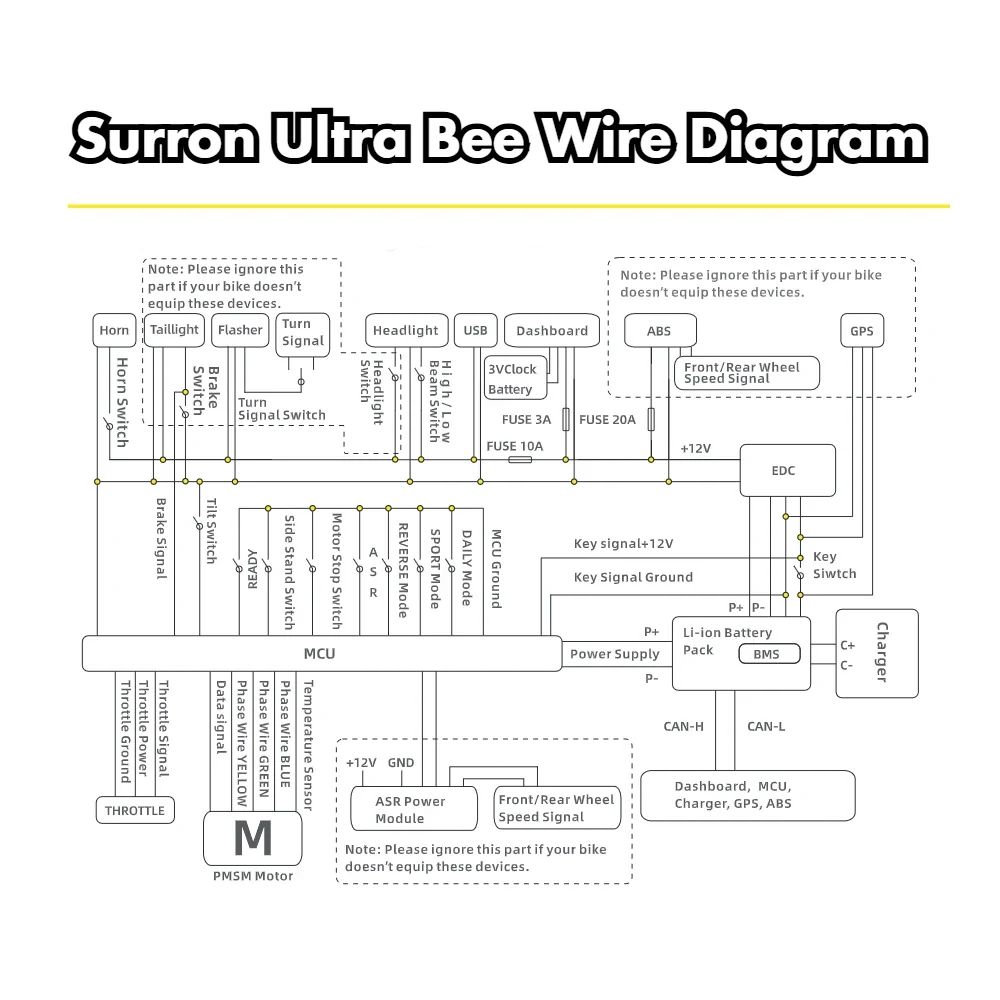
Wiring diagram
Trace power, CAN, controls, lighting, ABS, GPS, dashboard, charger, and motor connections without leaving the site.
Ultra Bee main wiring100%
Zoom with the controls or mouse wheel. Drag the diagram to pan. Double-click to reset.
POWER PATH
Battery → MCU → motor
The traction battery supplies P+ and P− to the motor controller. Three phase conductors feed the PMSM motor, with throttle, temperature, and position feedback returning to the controller.
COMMUNICATION
CAN-H and CAN-L
The battery BMS shares the CAN network with the dashboard, controller, charger, GPS, and ABS where fitted. Communication compatibility matters when changing batteries or controllers.
LOW-VOLTAGE SYSTEM
12 V accessories
The diagram separates the horn, lighting, switches, USB, dashboard, ABS, GPS, and wheel-speed signals from the high-current traction path.
Coming next
Charger connectors and pinouts
Send the connector photographs, diagrams, model/year, and which face is shown. They will be organized here by bike with pin numbering, voltage, signal purpose, and verification status.
Ultra BeeLight BeeLight Bee 2Hyper BeeOnewheelOther electric rides
EMR performance workshop
Charging, power and conversion hardware.
Chargers, motors, controllers, batteries, gearing, cooling, and mounting hardware have to work as one system. Ask before ordering—we verify the intended battery, full-charge voltage, connector set, and installation requirements.
Limited first production run
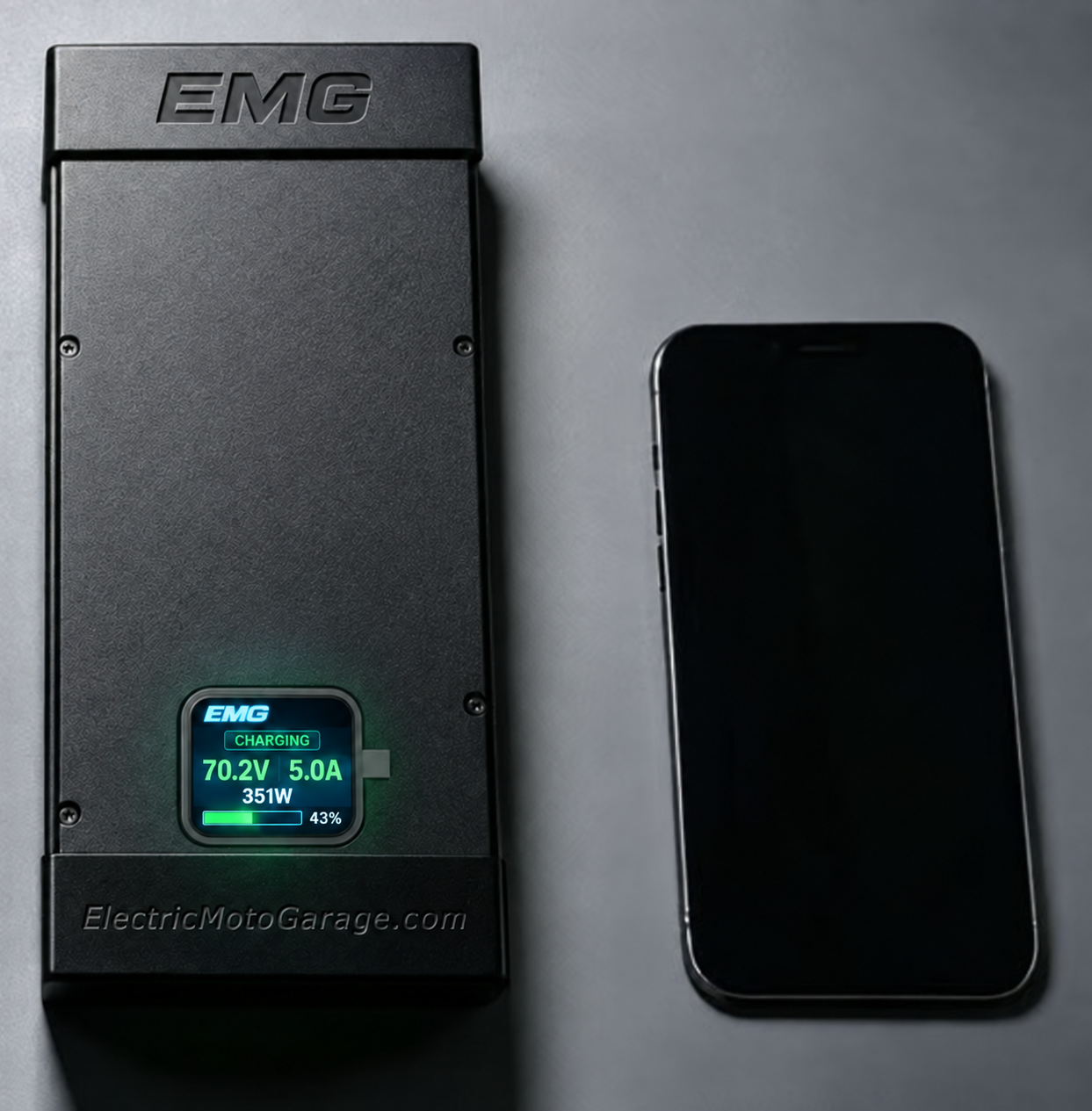
EMG programmable charger
$279preorder
A compact high-voltage charger with a live 1.5-inch control display, adjustable output, charge-session monitoring, and battery-specific setup by Electric Moto Garage.
Live voltage, current, power, temperature, and session energy
Programmable voltage and current within the configured operating range
110–120 / 220–240 V AC input
Battery-specific connector and full-charge setup confirmed before invoicing
First email received, first order priority.Leave your email to request a preorder. No payment is collected on this page.
Prototype shown. Final connector and charge profile are matched to the battery application.
Simple charge-only models
Choose the speed. Plug in and charge.
These fixed-rate models charge at one set current, like a factory charger. They are slower and simpler than the programmable model. The correct full-charge voltage and connector are selected for the battery before shipment.
1.5 A
Compact charger
$79
Charge-only operation at a fixed 1.5 A rate. Best for overnight charging and lower-demand use.
5 A
Standard charger
$129
Charge-only operation at a fixed 5 A rate. A familiar factory-style charging speed without programmable controls.
Input rating shown above is based on the supplied charger label. Safety-certification claims will be published only after the applicable certification file is verified.
Motor catalog
Bike-specific and fabrication-ready drives
Published figures below are 3Shul manufacturer claims. Final usable output depends on battery voltage, controller tune, cooling, gearing, duty cycle, and installation.
LIGHT BEE
SLB 65MX
72–108 V · up to 1,200 A phase · 12,000 rpm. Published peak output ranges from 42 kW at 72 V to 65 kW at 108 V, with 96 Nm at 850 A RMS.
Direct-fit performance motor for Sur-Ron Ultra Bee applications. Exact output and required supporting hardware will be verified for the customer's voltage and controller.
Larger geared motor for higher-output conversions. EMR can help plan the mounting envelope, drivetrain alignment, controller, and battery requirements.
Battery current and phase current are different. Never choose a controller from the headline current alone; voltage, cell capability, connectors, fuse, motor, cooling, and tuning must agree.
*The C350 and CL350 pages currently show “150K” in their headline but “15000” in a detailed field. EMR preserves that source conflict instead of silently choosing one. Confirm current firmware limits with 3Shul before purchase.
HYPER CONTROLLER
Ferox
36–92 V · 500 A battery · 1,100 A phase · 1,600 A peak · manufacturer-claimed 64 kW.
Mount plates, spacers, reduction stages, chain-line correction, guards, and battery trays will be listed here by motor and donor chassis. Fitment will be marked prototype, test-fit, or production—never assumed from a similar bolt pattern.
Motor envelopePivot and frame clearanceChain or belt lineReduction ratioFastener and material specificationCooling airflow
KTM electric motorcycle conversions
Complete conversion planning—not a mystery box.
Future packages will connect donor KTM chassis, motor, mount, reduction, controller, battery, charger, throttle, contactor, fuse, low-voltage system, dashboard, and waterproof connectors. Each build will state the donor model and year range it was actually measured against.
Donor bike→Mechanical fit→Power system→Harness→Test plan
EMR digital fabrication files
QS motor STL and CAD files
Each EMR file page will state what was measured, the intended use, file formats, revision, print or fabrication notes, and whether fitment was physically checked. Structural mounts will not be represented as ordinary hobby prints when the final part must be metal.
QS138 V3 70H CAD file
Indexable reference page for the motor envelope, mount design, fit-check workflow, STL and editable CAD formats.
Only items with a confirmed EMR SKU, an approved public price and stated shipping and tax handling appear here. Factory Sur-Ron parts, custom mounts and conversions stay on the inquiry flow so you get an accurate quote instead of a guess.
Choose a quantity to continue.
Prices, shipping and tax are calculated and verified by Electric Moto Garage before payment is requested. Payment is handled by PayPal; Electric Moto Garage never receives or stores your card details.